


Types of Aphasia
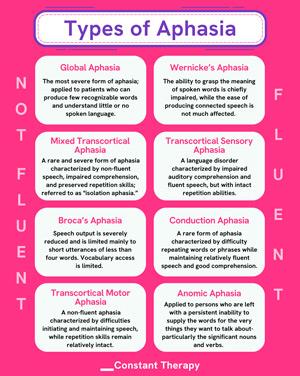
Global Aphasia, Broca’s Aphasia and Wernicke’s Aphasia, – what are all the different types of aphasia?
Different components of language may be damaged more or less in each individual with aphasia, resulting in different manifestations of speech and language difficulties. This infographic provides brief summaries of each of the most common aphasia types:
Global Aphasia: When a brain injury affects extensive portions of the front and back regions of the left hemisphere, the result may be global aphasia. People with global aphasia may have difficulty understanding words and sentences, forming words and sentences, and may get out only a few words.
Broca’s Aphasia: A type of nonfluent aphasia, these individuals typically present with damage that affects the brain’s frontal lobe. This aphasia can be called a “nonfluent” or “expressive” aphasia because they may understand and know what they want to say, but speak in short phrases produced with much effort. They may also omit grammatical words such as “is,” “and” and “the.” This is called “agrammatism”.
Wernicke’s Aphasia: A type of fluent aphasia, these individuals typically present with damage that affects the brain’s left temporal lobe. This aphasia can be called “fluent” or “receptive” aphasia because although people with this aphasia can produce many words (are “fluent”), and use grammatically correct sentences, what they say may not make sense, or their speech may include non-existent or non-relevant words. They also may not be fully aware that what they’re saying doesn’t make sense.
Anomic Aphasia: This is the mildest aphasia type – people with Anomic Aphasia have relatively preserved speech and comprehension, but difficulty in finding words. Interestingly, low-frequency words are typically more difficult for these people to retrieve and produce than frequently used words.
Primary Progressive Aphasia (PPA): A type of frontotemporal degeneration in which symptoms begin gradually, sometimes even before age 65, and worsen over time. People with PPA can lose the ability to speak and write, and eventually to understand written or spoken language. Speech therapy can be provided throughout the course of the disease, with the goal being to maximize communication ability for as long as possible.
Whether you have Broca’s Aphasia, Wernicke’s Aphasia, etc. this impairment affects an individual’s daily life in many ways – just think of what you’re doing right now – you’re reading this blog post or listening to someone read it to you. If your language is affected, you might not be able to read this blog, a newspaper, or even signs on the street. You might not understand your friend on the phone when they call you. You might be in a meeting and just cannot come up with any of the words you need.
Get the guide
Latest from the Brainwire blog
You know you’re a Speech-Language Pathologist (SLP) if…
The rest of the world won't get this. But you know who you are - you fellow Speech-Language Pathologists - who live to help kids and adults with speech, language, cognitive-communication, fluency, feeding, swallowing,... and oh so much more! We put together this list...

Parkinson’s Speech Therapy Exercises
Over 10 million people worldwide live with Parkinson’s Disease, a neurodegenerative disorder that can cause problems with movement, speech, language, thinking skills, voice, and swallowing. When left unaddressed, these challenges can make it difficult to participate...

Why do my Constant Therapy exercises seem too easy or too hard?
Has this been your experience: When you tried your Constant Therapy program for the first time, the exercises seemed either too easy or too hard? Or one exercise keeps repeating? Or one exercise seems to have nothing to do with the speech or cognitive issue you are...
Watch how-to videos
FOR PATIENTS
$
Need help? Contact the Support team
$
